
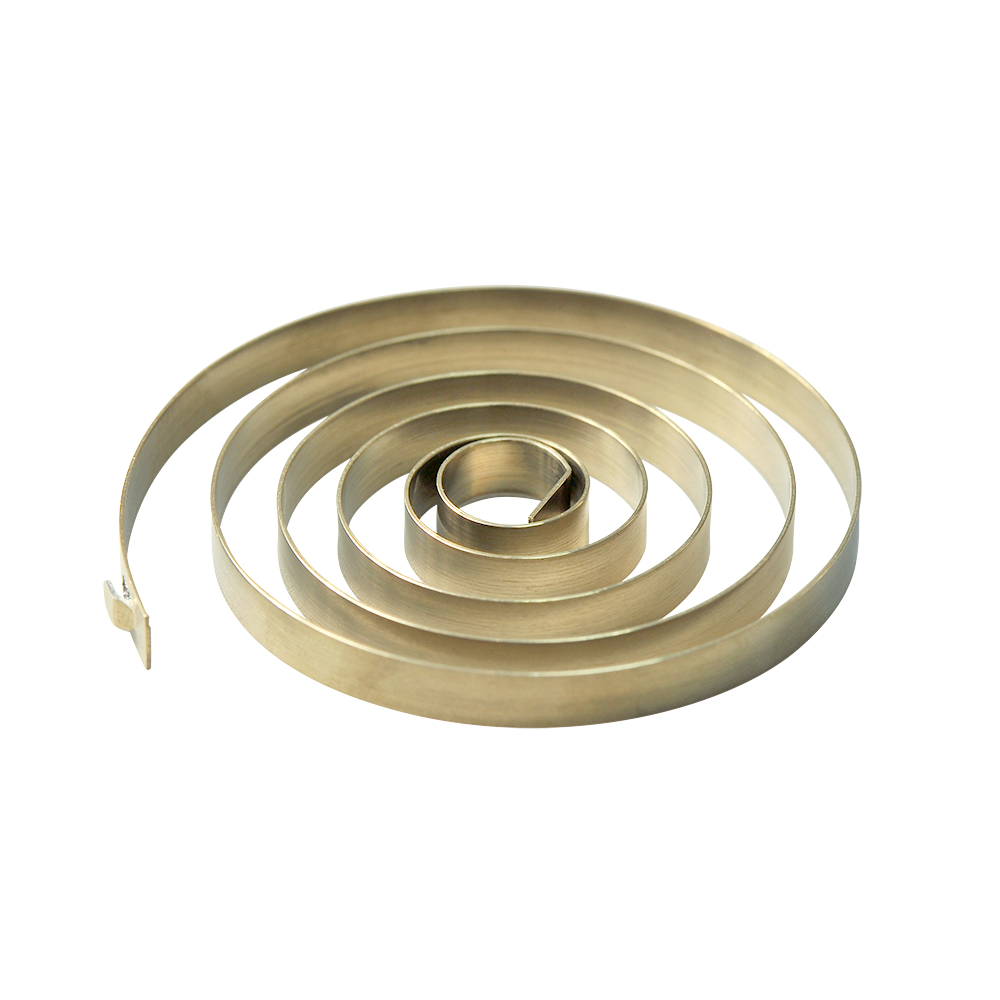
Spiral torsion springs are flat strip springs designed to store rotational energy and release torque within a compact space. They are commonly used in mechanisms that need return force, controlled rotation, rewinding, balancing, or mechanical energy storage.
For engineers, OEM buyers, and procurement teams, the main challenge is not only finding a spring that looks similar. The spring must match the available space, torque requirement, working angle, cycle life, material condition, and end connection. This guide explains how spiral torsion springs work, where they are used, and what details you should prepare before requesting a custom quotation.
What Are Spiral Torsion Springs?
A spiral torsion spring is made from a flat strip of spring material wound into a spiral shape. When the spring is rotated from its free position, it stores energy through bending stress in the strip. As it returns, it produces torque around the center of rotation.
This design is different from a helical torsion spring, which is made from round wire. A spiral torsion spring uses flat strip material, so it can often provide rotational force in a thin, compact package. It is useful when the assembly has limited axial space but still needs a controlled torque output.
Depending on the application, spiral torsion springs may also be discussed together with clock springs, flat spiral springs, power springs, or spring motor springs. The naming can vary by industry, so it is better to confirm the function, torque, travel, and installation method rather than relying only on a product name.
How Spiral Torsion Springs Work
Spiral torsion springs work by winding or unwinding around a center point. One end is usually connected to an arbor, shaft, or central fixing point. The other end is connected to the moving part, outer housing, drum, lever, or rotating component.
When the mechanism rotates, the spring strip bends and stores energy. The spring then tries to return toward its original position, creating torque. The final performance depends on strip width, strip thickness, material grade, number of turns, coil diameter, end design, and the working angle.
A well-designed spiral torsion spring should fit the installation space, deliver enough torque, avoid excessive stress, and provide stable operation over the expected service life. In custom applications, the spring is usually designed together with the surrounding mechanism, not as an isolated part.
Common Applications of Spiral Torsion Springs
Spiral torsion springs are used in products that require compact rotational force. They can support return movement, energy storage, controlled opening and closing, or rewinding functions.
| Application | Spring Function | Important Buyer Notes |
|---|---|---|
| Clock and timing mechanisms | Stores and releases rotational energy | Confirm torque stability, available turns, and assembly space |
| Retractable devices | Provides return or rewinding force | Check working angle, return speed, and end connection |
| Seat belt and safety systems | Supports controlled retraction | Requires strict performance validation and stable repeatability |
| Electrical and cable reels | Helps rewind cable, cord, or hose | Confirm reel diameter, load weight, and expected cycle life |
| Hinges, covers, and return mechanisms | Creates rotational return force | Review torque curve, stop position, and installation direction |
Spiral Torsion Springs vs Helical Torsion Springs
Both spring types can provide torque, but they are not interchangeable in every design. The best choice depends on the available space, motion angle, load direction, and required torque behavior.
| Comparison Point | Spiral Torsion Springs | Helical Torsion Springs |
|---|---|---|
| Material form | Flat strip spring material | Round wire or shaped wire |
| Typical space advantage | Compact axial height, useful for flat assemblies | Suitable for shaft-mounted lever movement |
| Common motion | Winding and unwinding around a central point | Angular deflection around the coil axis |
| Design focus | Torque, turns, strip stress, housing, and end form | Wire diameter, leg length, angle, shaft size, and load direction |
| Typical use | Reels, clock springs, retractors, spring motors | Clips, hinges, levers, covers, and mechanical arms |
Key Design Factors to Confirm
A spiral torsion spring may look simple, but small design changes can create a large difference in performance. Before choosing or customizing one, confirm the working conditions as clearly as possible.
- Required torque: define the starting torque, working torque, or return torque if your design has target values.
- Working angle or turns: confirm how far the spring needs to rotate during normal operation.
- Available space: provide outer diameter, inner diameter, width allowance, arbor size, and housing limits.
- Material requirement: choose carbon spring steel or stainless spring steel based on strength, corrosion resistance, and cost target.
- Cycle life: explain whether the product is used occasionally, daily, or in high-frequency service.
- End connection: confirm tab, hook, hole, slot, bend, or other custom end forms.
- Operating environment: include moisture, dust, temperature, chemicals, outdoor exposure, or vibration if relevant.
Material Options for Spiral Torsion Springs
Most spiral torsion springs use high-carbon spring steel or stainless spring steel. Carbon spring steel is often selected for strength, elastic performance, and cost efficiency. Stainless spring steel is more suitable when corrosion resistance is important, especially for humid, outdoor, or equipment-related applications.
Material is only one part of the design. Edge quality, heat treatment, surface finish, lubrication, and packaging can also affect performance. For export orders, it is useful to explain the working environment instead of only asking for a material grade.
RFQ Checklist for Custom Spiral Torsion Springs
If you need a custom spiral torsion spring, a clear RFQ can save time and reduce sampling mistakes. The more complete your application details are, the easier it is for the supplier to recommend a workable design.
| RFQ Detail | What to Provide | Why It Helps |
|---|---|---|
| Drawing or sample | 2D drawing, 3D file, photo, or physical sample | Confirms shape, size, direction, and end connection |
| Torque requirement | Target torque range or existing spring performance | Guides strip thickness, width, and coil design |
| Working rotation | Angle, number of turns, or travel range | Helps control stress and fatigue risk |
| Installation dimensions | Housing, arbor, shaft, drum, and width limits | Ensures the spring can fit and move correctly |
| Quantity and order stage | Prototype, trial order, or mass production estimate | Supports sampling plan, tooling discussion, and pricing |
| Application environment | Indoor, outdoor, humid, dusty, chemical, or high-cycle use | Supports material, surface, and packaging decisions |
Common Mistakes When Buying Spiral Torsion Springs
One common mistake is choosing a spring only by outer diameter. Diameter matters, but it does not explain torque output, stress level, or fatigue life.
Another mistake is ignoring the end form. If the spring end does not match the shaft, housing, or moving part, the spring may slip, deform, or fail during assembly. For custom products, the end connection should be reviewed together with the mechanism.
Buyers should also avoid asking for the strongest possible spring without checking the assembly. Excessive torque can damage plastic housings, make operation uncomfortable, or create safety problems during installation. A reliable design is based on balanced torque, controlled stress, and realistic working conditions.
FAQ About Spiral Torsion Springs
Are spiral torsion springs the same as clock springs?
They can be closely related, but the terms are not always used in the same way. A clock spring is often a flat spiral spring used for rotational return or energy storage. The best approach is to confirm torque, turns, size, material, and end design.
Can spiral torsion springs be customized?
Yes. Custom options may include material, strip width, thickness, coil diameter, number of turns, winding direction, end shape, heat treatment, and surface treatment. Drawings or samples help the supplier evaluate the design more accurately.
How do I choose the right spiral torsion spring?
Start with the required torque, working angle, installation space, cycle life, and application environment. If you are replacing an existing spring, provide photos, key dimensions, and a description of how the mechanism works.
What materials are used for spiral torsion springs?
Common choices include high-carbon spring steel and stainless spring steel. The right material depends on torque requirement, corrosion exposure, service life, cost target, and whether the spring works in a protected or exposed environment.
Need Help Choosing Spiral Torsion Springs?
If you are developing a new mechanism or replacing an existing spring, prepare your drawing, sample photo, target torque, working angle, housing dimensions, material preference, and estimated quantity. With these details, a spring manufacturer can review the application and suggest a practical spiral torsion spring design.
Suggested CTA: Request a Quote